what is the EGO ? I , like many others struggled to understand what the ego is. what is its function and why do we even have an EGO.
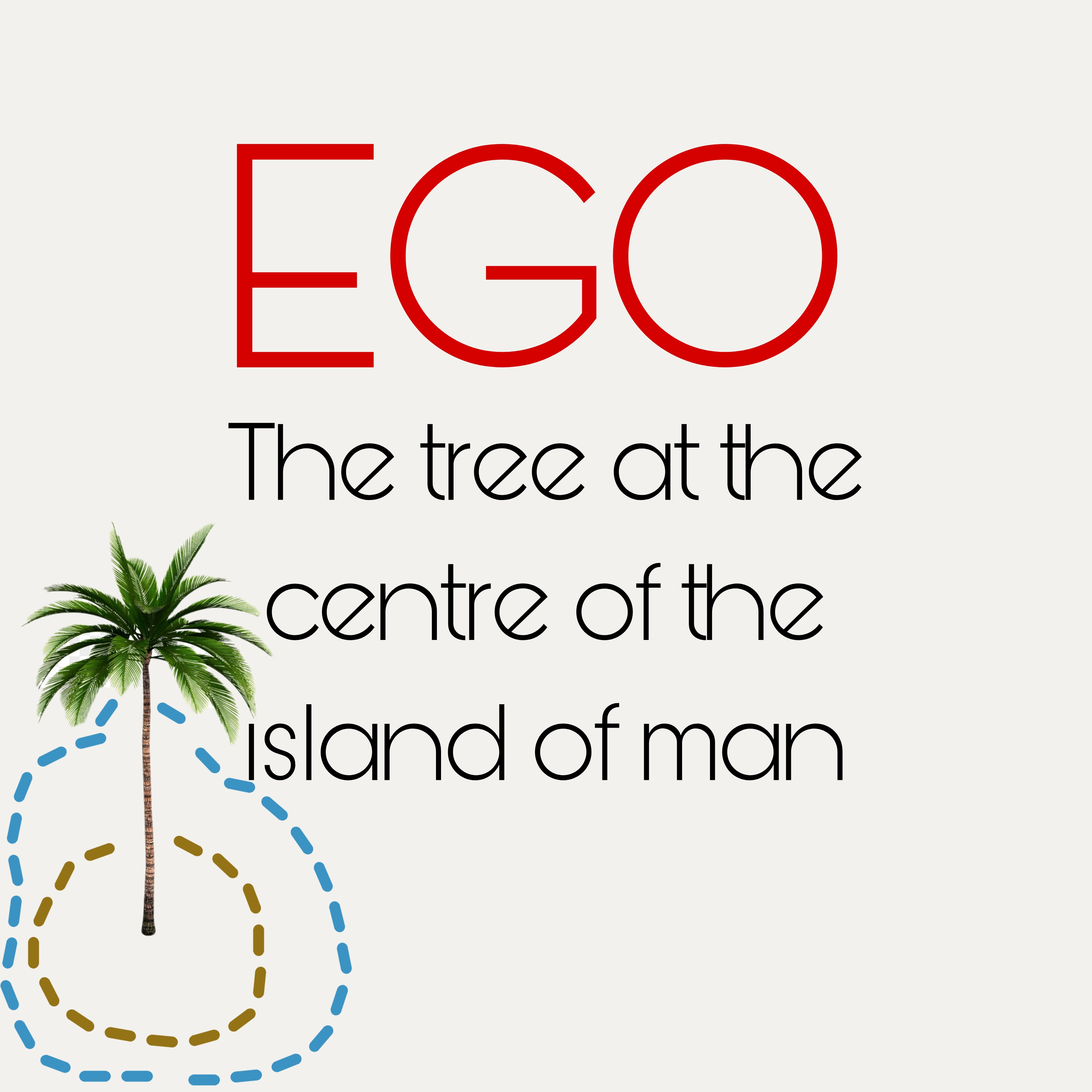
if man was an island and the inhabitants of that island being thoughts, feelings and desires. EGO is a tree at the centre of that island. In other words EGO is the part of the conscious mind that dictates I . It is the part of you that can speak and guide this physical body and react to external stimuli and internal stimuli such as emotions. If man was an island then the sea is the network holding all islands, so called the collective consciousness. The EGO is an adaptive mechanism which gives this island a sense of self. the ability to decide and choose right from wrong and good from bad in other words it is a survival mechanism which helps us navigate ourselves in this complicated beehive which we call the world.
the EGO expressed as this tree, can be fed. if the EGO is fed with positive reinforcement within a healthy growth environment it will flourish into a beautiful tree which can provide shade for those who need it, and it can withstand great winds however if this tree grows in an unhealthy environment and is fed with negativity it will grow frail and weak, a weak sense of self and trust in ones own ability and many other complications which can arise. An individual with a weak, unhealthy EGO will react negatively to external stimuli.
DR. CARL JUNG
In Carl Jung’s analytical psychology, the EGO is the centre of consciousness and the part of the psyche responsible for our sense of identity, continuity, and personal agency. Jung viewed the ego as the organiser of conscious experience: it gives coherence to thoughts, memories, and perceptions, allowing a person to say “I am.” Although essential for navigating daily life, the EGO represents only a small portion of the total psyche. It emerges from the interaction between innate predispositions and lived experiences, forming through differentiation from the unconscious. For Jung, the EGO must maintain a balanced relationship with the personal unconscious (repressed or forgotten experiences) and the collective unconscious (archetypal patterns shared across humanity). Psychological growth, what Jung called individuation, requires the EGO to acknowledge and integrate these deeper layers rather than be dominated by them. When the EGO becomes too rigid or inflated, it disconnects from the unconscious and creates inner conflict; when too weak, it is overwhelmed by unconscious impulses. Thus, in Jung’s theory, the EGO is not the whole self but a vital, dynamic point of orientation within a much larger, complex psychic system.

This diagram was posed by DR CARL JUNG to help explain the complex structure of the psyche in visual terms.
The EGO is expressed as the backbone of the persona because the EGO or in other terms (what I want ) is the driving factor behind the persona or how we express the needs of I as the individual or the EGO to the outside world sort of like the computer programming which drives our behaviours.
DR SIGMUND FREUD
In Freud’s psychoanalytic theory, the EGO is the rational, problem solving component of the personality that mediates between the instinctual demands of the ID , the moral restrictions of the superego, and the realities of the external world. Importantly, Freud emphasised that the EGO is not limited to conscious awareness it spans conscious, precocious, and unconscious levels of the mind. The conscious EGO includes the thoughts, perceptions, and decisions we are immediately aware of such as our basic human needs e.g the need for food “I need food”. The preconscious EGO contains memories and information that are not currently in awareness but can be easily brought into consciousness when needed, such as knowledge or past experiences. The unconscious EGO consists of deeper processes that guide behaviour automatically, including defence mechanisms like repression, denial, or projection. These unconscious operations protect the individual from anxiety by managing conflicts between the ID’s impulses and the superego’s moral demands. Overall, Freud saw the EGO as the executive agent of personality rooted partly in awareness but largely operating behind the scenes responsible for balancing internal drives, moral standards, and social reality to maintain psychological stability.

DR Freud’s iceberg theory demonstrates this knowledge visually. Individuals have levels to their consciousness, each holding code that can help an individual navigate external and internal stimuli critical to the individuals survival and helping them achieve their desires. some motives such as ones kept in the unconscious may not even be known to the individual however they secretly dictate the actions of that person. Other preconcious codes such as experiences stored in memory will dictate how an individual will react to new events or external stimuli based on previous ones e.g if I was to have a negative experience from someone of a certain race i am more likely to associate that trait with people of that race, followed by the conscious mind which holds easier to comprehend surface level thoughts and perceptions on an active basis which then are processed and sent down this iceberg accordingly. DR Freud also recognises that we all have primitive drives that every human is born with due to evolution.
primitive drives
primitive drives that Freud believed every human is born with due to evolution and survival such as the ID which is the most instinctual part of the personality, operating entirely in the unconscious and driven by the pleasure principle meaning it seeks immediate satisfaction, regardless of consequences or social rules.
These instinctual demands include:
Biological drives
-
Hunger
-
Thirst
-
Sleep
-
Avoidance of pain
The ID pushes the person to satisfy these needs instantly.
2. Sexual and life-preserving instincts (Eros)
3. Aggressive and destructive instincts (Thanatos)
How this creates pressure on the EGO
These instincts operate impulsively and irrationally. For example:
-
If you’re hungry, the ID wants you to eat right now.
-
If you’re angry, the ID may push toward hitting or shouting.
-
If you desire pleasure, the ID wants immediate gratification without considering consequences.
The EGO’s job is to manage these instinctual demands in realistic, socially acceptable ways. It prevents a person from acting on raw impulses by considering reality, morals, and long-term consequences of actions that drive you towards these needs and desires .
So, “instinctual demands of the ID” simply means the powerful, automatic urges we all have that push us toward immediate satisfaction and survival even when those urges conflict with social rules or logic. An individual’s Ego can be both healthy and unhealthy, the EGO’s health is determined by many factors.
EGO HEALTH
Whether the ego becomes healthy or unhealthy depends on early development, emotional experiences, social environment, and how well a person learns to regulate their feelings and needs.
Healthy Ego
A healthy ego is flexible, realistic, and grounded. It allows a person to function with confidence while still being able to acknowledge flaws, limitations and view the world with clarity.
What fuels a healthy ego
- Secure attachment in childhood (consistent love, safety, Atonement)
-
Validation and healthy boundaries
-
Opportunities for mastery (successes, competence building)
-
Realistic expectations from caregivers
-
Emotional regulation skills
-
Ability to tolerate discomfort and delay gratification
Characteristics
-
Good self-esteem without arrogance
-
Can handle criticism without falling apart
-
Makes balanced decisions
-
Controls impulses
-
Able to see others’ perspectives as well as their own
-
Accepts mistakes and learns from them
Unhealthy Ego
An unhealthy ego develops when the person’s balance between inner drives, moral pressure, and reality becomes distorted. It may become either inflated (fragile but grandiose) or fragmented (weak and unstable).
What fuels an unhealthy ego
-
Inconsistent or neglectful care giving
-
Trauma or chronic stress
-
Over protection or excessive praise (leading to fragility and entitlement)
-
Harsh criticism or shame-based parenting
-
Lack of boundaries
-
Unmet emotional needs in childhood
Characteristics
Inflated ego:
-
Arrogance, defensiveness, superiority
-
Requires validation constantly
-
Collapses under criticism
Fragile/weak ego:
Both types are rooted in insecurity.
What experiences shape EGO development
Freud believed the EGO forms through navigating early childhood conflicts, especially around needs, frustration, and parental expectations. Experiences that build a healthy, strong EGO include:
Experiences that lead to an unhealthy EGO include:
-
Frequent punishment or shame
-
Emotional neglect
-
Trauma or instability
-
Overindulgence or no limits
-
Constant criticism or unrealistic expectations
In short:
A healthy EGO manages reality with confidence and flexibility, while an unhealthy EGO struggles to balance inner drives, self-image, and external demands. The difference comes largely from early emotional environments, the presence of consistent care giving, and the development of coping skills.
overall we can see that the EGO is a complex yet essential part of the human psychological complex adapted in order to improve the chance of survival and reproduction of the individual whilst helping them navigate self within this world.
it is important that one recognises their STATE OF EGO and active action such as recognition, learning and self improvement is taken in order to achieve understanding and progression.
Since you have been kind enough to read this far a bonus piece of knowledge which can help you understand the EGO is the concept of RASTA-FAR-I where individuals refer to one another as I & I this concept is the acception that you and brother man are one. It is the understanding that you accept others as yourself, where you choose to see them from the same light that you would see yourself. You see I (another) AS PART OF I (self).
THE ISLAND OF MAN.

Morezaie.com
Psychological writing & research
find below a list of useful papers that I 😉 can refer to in order to learn more about the EGO.
-
Freud, S. (1923). The Ego and the Id. In J. Strachey (Ed. & Trans.), The Standard Edition of the Complete Psychological Works of Sigmund Freud (Vol. 19, pp. 12–66). Hogarth Press. web.english.upenn.edu
— Foundational statement of Freud’s structural model (id, ego, superego); essential primary source.
-
Jung, C. G. (1954). The ego and the unconscious. In Collected Works of C. G. Jung (Vol. 7). Princeton University Press. (See also Edinger, E. F., Ego and Archetype, for Jungian interpretation.) pacifica.libguides.com+1
— Jung’s perspective on the ego and its relation to the Self and individuation (classical Jungian view).
-
Loevinger, J., & Blasi, A. (1976). Ego development: Conceptions and theories. Jossey-Bass. Internet Archive
— Seminal work on stages of ego development and measurement (Loevinger’s stage model).
-
Marcus, E. R. (1999). Modern ego psychology. Journal of the American Psychoanalytic Association, 47(2), 339–357. PubMed
— Review of the evolution of ego psychology and its contemporary status in psychoanalysis.
-
Solms, M. (2012). The “Id” knows more than the “Ego” admits: Neuropsychoanalytic integration of affect and cognition. Frontiers in Psychology / Neuropsychoanalysis (open access). PMC
— Influential neuropsychoanalytic paper arguing for integration of Freudian constructs with modern neuroscience.
-
Carhart-Harris, R. L., & Friston, K. (2010). The default-mode, ego-functions and free-energy: A neurobiological account of Freudian constructs. Brain, 133(4), 1265–1283. OUP Academic
— Proposes mappings between Freud’s ego functions and large-scale brain networks (DMN & predictive coding).
-
Johnson, B. (2016). Using neuroscience as the basic science of psychoanalysis. Frontiers in Psychology (Neuropsychoanalysis). PMC
— Argues for neuroscience as a complementary empirical base for psychoanalytic theory (clinical implications).
-
Levorsen, M., et al. (2023). The self-concept is represented in the medial prefrontal cortex. Social Cognitive and Affective Neuroscience. PMC
— Recent neuroimaging evidence linking the self / self-concept (overlapping with ego constructs) to mPFC.
-
Rizzolatti, G., & Sinigaglia, C. (2014). Linking psychoanalysis with neuroscience: The concept of the perceiving/acting ego (review). Neuroscience & Biobehavioral Reviews. ScienceDirect
— A review highlighting convergences between neurophysiology and psychoanalytic concepts of agency/ego.
-
Conci, M. (2023). From psychoanalytic ego psychology to relational perspectives: contemporary reviews. International Journal of Psychoanalysis / Psychotherapy Reviews. Taylor & Francis Online
— Very recent perspective on how ego-focused psychoanalytic models have evolved into relational/attachment-informed approaches.

Leave a Reply