
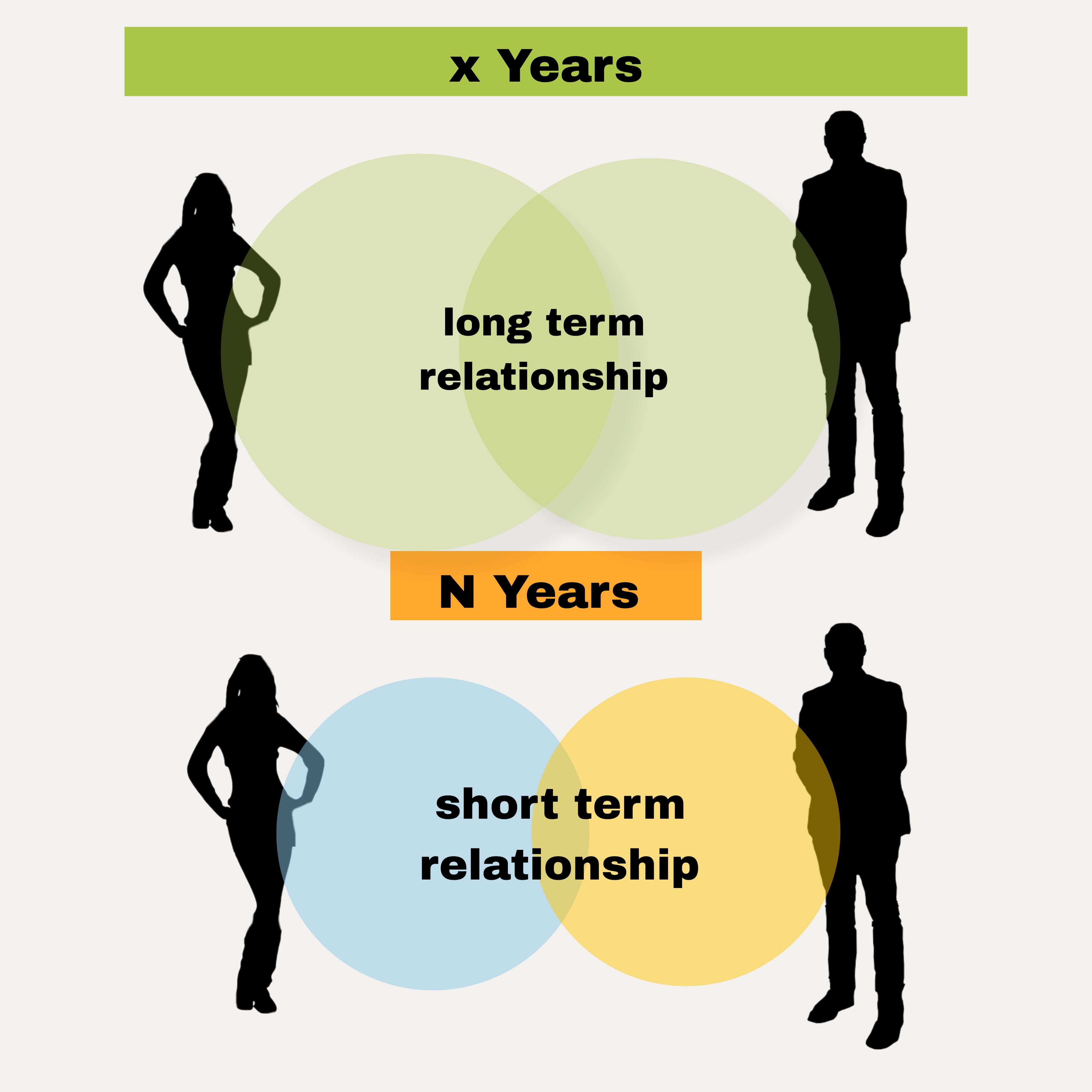
From a psychological perspective, dating for sexual intercourse and dating for marriage often involve overlapping behaviours (e.g., attraction, attachment and intimacy), but they are typically driven by different motivational systems, expectations, and cognitive-emotional processes. Contemporary research in relationship psychology suggests that these are not simply “different stages of the same thing,” but can reflect distinct mating strategies shaped by personality, attachment style, and long-term life goals or reasons for beginning a romantic relationship with another .
Psychological differences between dating for sex and dating for marriage
Dating primarily for sexual intercourse is usually associated with short-term mating orientation, where the immediate goals are sexual gratification, novelty, physical attraction, and lower relational commitment. In contrast, dating for marriage is more closely aligned with long-term pair-bonding orientation, where individuals prioritise emotional security, compatibility, shared values, and future planning. Recent evidence indicates that these are not opposite ends of a single spectrum, but two partly independent psychological dimensions: a person may have strong motivation for sexual variety while also desiring a stable pair bond, or may prioritise one without the other, humans exhibit a variety of mating strategies motivated by their goals, being conscious or subconsciously.

A central construct explaining this difference is sociosexuality, defined as the willingness to engage in sex outside a committed relationship. Individuals with an unrestricted sociosexual orientation are generally more comfortable with casual sex and tend to evaluate potential partners heavily on immediate attractiveness and sexual chemistry. Those with a restricted sociosexual orientation tend to associate sexual intimacy with emotional closeness and commitment, making them more likely to date with marriage or long-term partnership in mind, goal orientation can often be influenced by cultural or religious background. Importantly, sociosexual orientation is linked to broader personality traits such as impulsivity, sensation-seeking (pleasure/romance addiction) some become unconsciously addicted to the rollercoaster of chemical reactions which are the result of partner seeking and relationship climax, and lower conscientiousness, while long-term mating orientation correlates more strongly with agreeableness, attachment security, and future-oriented decision making, it is the preference of some individuals to choose a stable mate for the long term.
Attachment theory
Attachment theory helps explain how early relationships with caregivers influence the way people approach mate selection and romantic dating in adulthood. According to Bowlby’s attachment framework, individuals develop internal working models of relationships based on whether early caregivers were responsive, consistent, or emotionally unavailable. These models shape expectations of intimacy, trust, and dependence in later life. In dating psychology, people with secure attachment are generally more likely to seek emotionally stable partners and prioritise qualities such as trustworthiness, communication, and long-term compatibility. This means they often approach mate selection with a greater openness to emotional intimacy and commitment, as they have a positive perception on mate seeking and partner selection, making them more inclined to pursue relationships that support long-term bonding, including marriage.
By contrast, individuals with insecure attachment styles such as anxious or avoidant attachment, often show different patterns in partner choice and dating behaviour. Anxiously attached individuals may be drawn to partners who provide reassurance but can also become overly concerned with rejection, which may lead them to choose partners based on fear of abandonment rather than compatibility or other flawed selection strategies which are bound for failure. Avoidantly attached individuals may prioritise independence and emotional distance, making them more likely to engage in casual or low commitment dating, where sexual intimacy may occur without deep emotional closeness. In this way, attachment theory suggests that mate selection is not based solely on conscious preferences like attractiveness or shared values, but is also strongly shaped by unconscious relational patterns formed early in life, influencing whether individuals seek short-term encounters, long-term attachment, or struggle to form stable romantic bonds due to lack of experience both direct and indirect.
Secure attachment

Insecure attachments

Emotionally, dating for sex often involves a lower threshold for vulnerability. Because the relationship is not expected to endure, individuals may consciously or unconsciously avoid deep self-disclosure and emotional interdependence due to a fear of vulnerability and abandonment which a sex driven relationship entails. This can create what psychologists call a low-investment relational frame, where the perceived cost of rejection or breakup is lower. In contrast, dating for marriage generally activates a high-investment frame, where partners become more attentive to trust, reliability, and long-term compatibility because the stakes such as emotional, social, and often financial are perceived as much higher. This leads to more deliberate partner evaluation, including assessment of character, family values, and conflict-resolution ability, there is a great tendency to connect and invest in and with another once there is the understanding that “we are bound for life”.
Attachment theory also provides insight into relationship formation and type of relationship an individual wishes to seek. People pursuing casual sexual relationships are statistically more likely to show avoidant attachment patterns, where intimacy may be desired physically but emotional dependence is resisted. By contrast, those dating for marriage more often seek secure attachment: a relationship characterised by emotional availability, trust, and mutual caregiving. However, this is not absolute ; securely attached people may also engage in casual relationships, but they tend to report clearer communication and lower psychological distress and are less likely to experience patterns of negative perception due to them being less likely to have experienced negative relational distressers in the past for example “what if he’s out cheating on me”. Individuals are less likely to run into major relational distressors compared with insecurely attached individuals, individuals with securely attached families have the tendency to seek marriage sooner than those that are not, as they become aware of the fact that once it is the end of the day and they are alone they need someone to lean on, it is simply within our human nature to keep a mate for life, secure attachment observed in childhood becomes the foundation for attachment formed in adulthood.
Neurobiologically, sexual and marital-oriented dating can engage different reward processes. Casual sexual encounters are strongly linked to immediate dopaminergic reward systems, novelty, excitement, anticipation and climax, usually it is individuals who have lost sense of pleasure in other aspects of their life such as occupation so they channel their energy and receive their meaning through seeking pleasure from multiple partners.
Marriage-oriented relationships increasingly rely on pair-bonding mechanisms involving oxytocin, vasopressin, and neural pathways related to long-term attachment and social memory. It is usually psychologically mature and stable individuals who seek marriage and long term commitment. Research published in 2024 highlights that pair bonding involves co-ordinated neural systems that reinforce selective emotional attachment beyond sexual attraction alone. This helps explain why long-term romantic relationships often transition from intense passion to a deeper sense of companionship and commitment.
Another key psychological distinction is how each type of dating shapes partner selection criteria. When seeking sex, people often place greater emphasis on visible cues such as physical appearance, charisma, and short-term excitement.
Although physical attraction is the foundation of mate selection, when seeking marriage, selection expands beyond mere physique to include traits linked to stability: emotional maturity, kindness, financial responsibility, and compatibility in life goals. This aligns with evolutionary and social psychology findings that humans often employ dual mating strategies ( a difference in level of commitment and emotional investment), one strategy optimised for short-term attraction and another for long-term cooperative partnership. Although my personal belief is that anyone could be anyone’s partner if there is will and patience to understand and adapt to their partner mutually, selection and goal of selection is dependent on a variety of factors, media consumption, health perception, religious and cultural background which all create a psychological selection bias .
Critical nuance
It is important not to reduce this distinction to a moral hierarchy. Dating for sex is not inherently less psychologically meaningful, nor is dating for marriage automatically healthier. The psychological impact depends largely on whether an individual’s behaviour matches their values and expectations. Distress often arises when there is goal in-congruence and no mutual input to resolve life stressors, for example dealing with life stressors such as moving for work or compatibility miscommunication / deception, when one person dates for emotional commitment and long term relation building in mind while the other dates primarily for sexual access. In such cases, mismatched intentions can produce anxiety, lower self-esteem, and relational mistrust and create relational trauma which can be healed to produce a stronger relationship or broken further resulting in the breaking of a relationship depending on how the individuals involved in the relationship handle the discrepancy.
overall we can observe in society that humans are social organisms and require intimacy, it is simply a basic need, the difference is how that need is met and through extended observation one can observe that we call come to the conclusion of marriage (long term commitment) being the least problematic and most fulfilling way to meet those needs, the difference being is the period of time it takes an individual to realise that long term commitment is the most fulfilling way to meet their needs rather them short term pleasure based commitments.
Suggested academic references (APA style)
- Hendrickson, J., Peters, S., French, J., & Maner, J. K. (2024). Distinct individual differences in motivations for pair-bonding and sexual behavior: Implications for close relationships. Personality and Individual Differences, 230, 112779. https://doi.org/10.1016/j.paid.2024.112779
- Thurston, L. T. (2024). Pair-bonding on the brain. Communications Biology, 7, 75. https://doi.org/10.1038/s42003-023-05711-3
- Blumenthal, S. A., & Young, L. J. (2023). The neurobiology of love and pair bonding from human and animal perspectives. Biology, 12(6), 844. https://doi.org/10.3390/biology12060844
- Penke, L., & Asendorpf, J. B. (updated contemporary applications discussed in 2024 literature). Beyond global sociosexual orientations: Distinct motives for casual sex and pair bonding.
Rogier, G., et al. (2024). Attachment style, emotion dysregulation and sexual satisfaction among polyamorous and non-polyamorous individuals. Sexuality & Culture, 28, 354–369.
Leave a Reply